Los Angeles Police Department
Inherent ViceThe Los Angeles Police Department is the novel’s principal law-enforcement institution, but it is never merely a neutral backdrop to Doc Sportello’s investigations. Its detectives pursue a homicide and a disappearance while moving through a culture of internal loyalties, political pressure, racialized policing, and unofficial force. The department’s reach extends beyond its offices: it helps shape the conditions under which communities are displaced, countercultural gatherings are treated as threats, and inconvenient cases can be classified as closed before their central questions are answered.
Structure and Institutional Atmosphere
The department’s institutional world is concentrated in two contrasting settings. Parker Center, known to Doc as the Glass House, looks harmless among the older downtown architecture, but its neutral drapes and fluorescent corridors conceal what he imagines as an alternate history of cop politics: family dynasties, heroes and villains, and loyalties insulated from the public. For Doc, this is Bigfoot’s natural element, the large-scale police world he had been eager to reach after leaving the beach. The building’s apparent transparency thus sits uneasily beside the secrecy Doc senses within it.
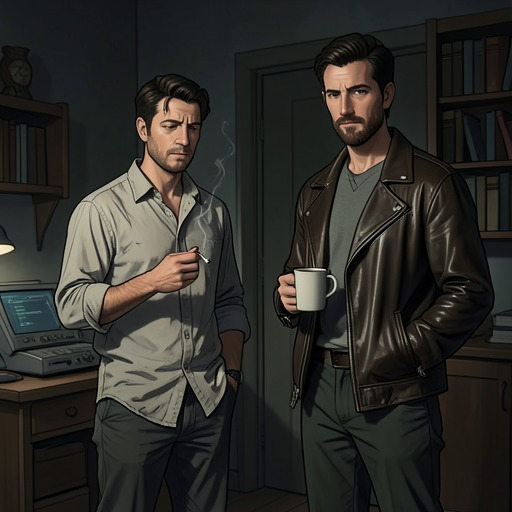
The Homicide unit offers no orderly private offices. Bigfoot receives Doc in an oversized shared room where detectives work at two long tables, smoke, drink coffee from paper cups, shout into telephones, order meals, and miss the wastebaskets. The noisy, cluttered space makes police work look both ordinary and improvised, far from the commanding image of a self-contained investigative machine. Bigfoot himself is at home in this environment, but his power within it does not erase the department’s dependence on informal relationships and unspoken rules.
The department’s public image also intrudes into everyday life through Bigfoot’s commercials for Channel View Estates. The detective who investigates the violence surrounding the development is also its television spokesman, appearing in advertisements that interrupt films. That collision between police authority and real-estate promotion connects the department not only to criminal investigations but to the commercial transformation of the landscape.
Investigations and the Use of Police Power
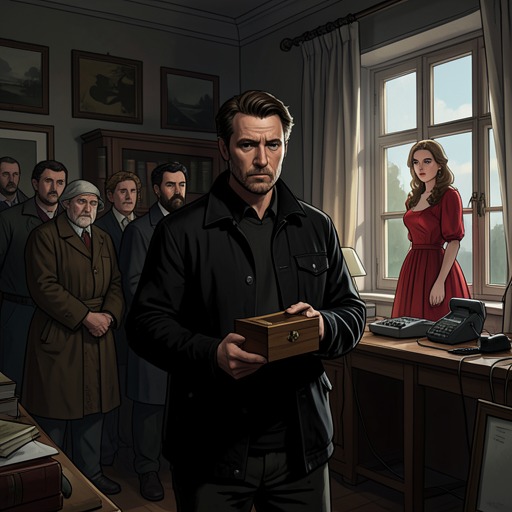
After Doc is found unconscious at Chick Planet Massage, Bigfoot greets him in custody and treats him as a suspect in the Channel View Estates case. Bigfoot lays out the department’s immediate problem: gunfire has left Glen Charlock dead, while Michael Z. Wolfmann, the man Charlock was supposed to guard, has disappeared. With less than twenty-four hours before federal authorities may classify the disappearance as a kidnapping and intervene, Bigfoot wants the names of Doc’s supposed associates. He frames cooperation as a possible way to improve Doc’s position before trial, turning the pressure of a criminal case into leverage for information.
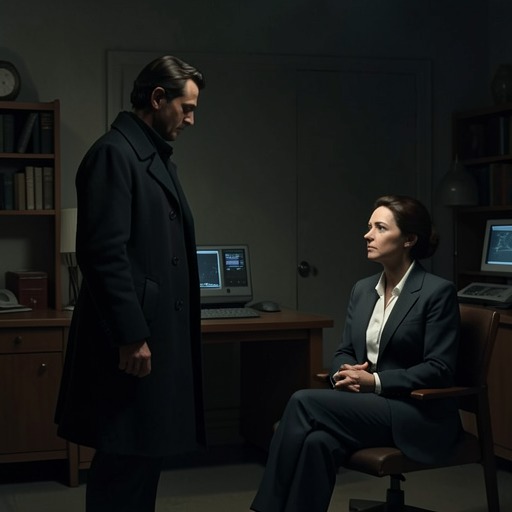
The department’s scrutiny of Doc is not confined to that interrogation. On another occasion, Bigfoot pulls up beside him in a marked car and needles him about being in the wrong neighborhood to buy marijuana. The encounter is casual in form but carries the force of police attention: Bigfoot can approach Doc as a familiar adversary, while the uniformed car makes clear that the exchange is backed by institutional authority. Doc’s later visit to Parker Center brings him into the department’s formal setting, where he tries to explain what he knows while remaining wary of how that knowledge will be used.
Doc also encounters officers exercising authority through a program called Cultwatch. During a roadside stop, police describe any gathering of three or more civilians as a potential cult and use a checklist that includes references to Revelation, long hair, and distracted driving. The officers’ criteria make countercultural identity itself legible as a police concern. Their jitteriness reflects the post-Manson atmosphere in which ordinary signs of nonconformity can be recast as evidence of danger.
The department’s treatment of Coy Harlingen’s suspected overdose reveals a different weakness: a case can disappear administratively without its underlying questions being resolved. Bigfoot brings Doc deteriorated papers in a Ralph’s bag and says that multiple law-enforcement offices and levels of power had been involved in Coy’s life under several aliases. Some of those interests, he recognizes, would not mind if Coy were truly dead. Yet the death had not been designated a homicide, so the usual progress reports were never required; it could remain, on its face, one more overdose and one fewer addict, the case cleared. Police attention has touched Coy from many directions, but the procedural classification has prevented that attention from producing an accountable investigation.
Reserves, Racialized Policing, and Urban Space
The distinction between the department and its auxiliary forces is unstable. After Doc supplies license-plate numbers, Fritz discovers that some vehicles belong to members of the Los Angeles Police Reserves. He describes men who joined during the Watts uprising so that they could attack Black residents under legal cover, and says they later served as a private militia when the department wanted to avoid looking bad in the press. The account links the reserves’ origin in racial violence to their continuing usefulness as an deniable instrument of police power.
The department’s entanglement with racialized violence is set against a longer history of land seizure. Tariq Khalil recalls that South Central had been a Japanese neighborhood before the Second World War, when Japanese American residents were sent to camps and Black families moved into the area in their place. He sees Channel View Estates as the next stage in a repeated process of removal. Aunt Reet’s knowledge of land use gives this history a local, material dimension: her account of the land reaches beyond deeds and contracts to buried family conflicts and the changing course of water. The novel places police institutions inside this geography of displacement rather than outside it.
Doc’s visit to Channel View makes the transformation visible in the landscape itself. Signs on Artesia direct him to a development promoted as “A Michael Wolfmann Concept.” Model homes and finished houses give way to exposed construction skeletons spreading into unincorporated land; the Spanish Colonial styling offers an image of established affluence before there are shade trees on the streets. Black pedestrians appear at the edges of Doc’s view, perhaps searching for a neighborhood that has been taken away. The development’s polished sales image and its underlying history of bulldozing coexist, while the police presence surrounding the project is implicated in the struggle over who may remain in place.
The racial climate is also registered in Gordita Beach, where the sight of a Black motorist once triggered calls for backup, a task force, and roadblocks along Pacific Coast Highway. That response is traced to a postwar effort to prevent a Black family from settling in town: with the Ku Klux Klan’s advice, residents burned the family’s house, and the site remained empty until it was eventually made into a park. The community’s memory of racial exclusion and its police reflexes overlap. The department’s authority is therefore encountered not only in investigations but in a wider landscape where access, belonging, and suspicion have been unequally distributed.
Compromise and Narrative Significance
Doc’s view of Bigfoot changes when he hears about the police reserves. He had once worried about becoming a diligent investigator who followed only official leads, and that unease had helped him give Bigfoot some latitude. Learning of the reserves’ role makes him wonder whether Bigfoot has a connection to the vigilantes and perhaps to the Channel View raid. The connection remains a suspicion rather than a confirmed fact, but it alters the terms of their relationship: the detective who had seemed like an abrasive representative of ordinary police work may also be near a system that employs unofficial force.
Bigfoot’s reopening of the Coy file complicates that distrust. He has gathered the neglected paperwork, recognized the reach of the overlapping interests in Coy, and brought the material to Doc away from the office. His investigation shows an individual detective pushing into a case the department’s prior classification had rendered inert. Yet even this effort exposes how easily institutional procedure can convert uncertainty into closure: without a homicide designation, the reporting obligations vanish, and the file can be treated as settled.
The department thus operates in the novel as both investigator and part of the political terrain under investigation. Its officers pursue Doc, question him for privileged client information, and monitor gatherings, while police reserves provide a channel for force that can be disavowed. Its files and classifications determine which deaths demand explanation and which can recede into paperwork. Against the familiar language of protection and service, the novel places a city where policing, real-estate development, racial displacement, and institutional self-protection repeatedly occupy the same ground.